
Wednesday, 20 June 2012


Worlds in Transit
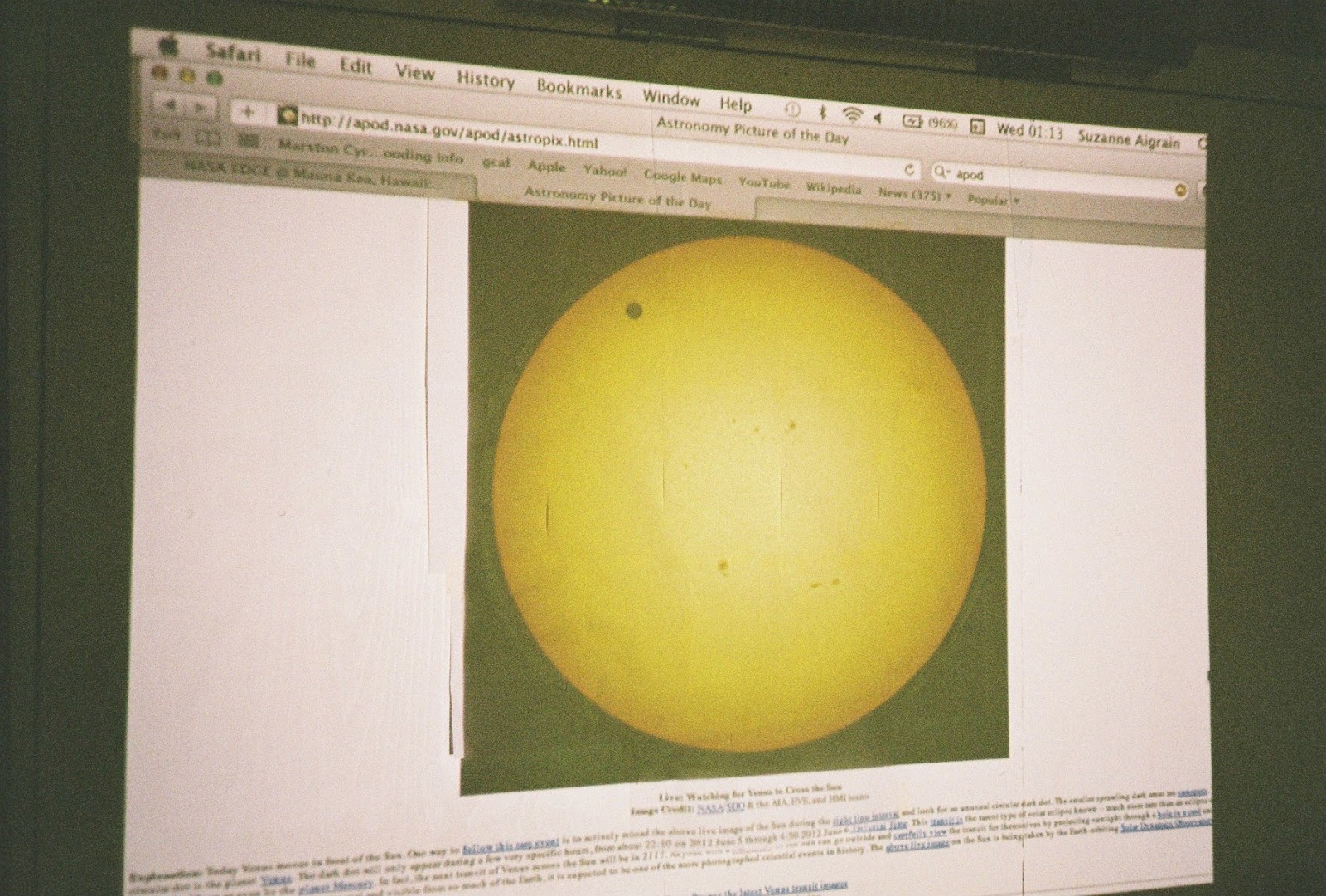
Earlier this month I took a trip to northern Sweden with www.super-collider.com to watch Venus as it passed directly between Earth and the Sun.
We travelled to Floda (http://www.floda31.com) as it doesn't get dark so we were hoping to see most of the transit. However it DOES get cloudy, and we almost gave up on the idea of seeing anything at all - but in the early hours of the morning, the clouds parted and we caught the last two hours.
Below: miscellaneous picture from the trip taken on my little 35mm Olympus. More to follow.



We travelled to Floda (http://www.floda31.com) as it doesn't get dark so we were hoping to see most of the transit. However it DOES get cloudy, and we almost gave up on the idea of seeing anything at all - but in the early hours of the morning, the clouds parted and we caught the last two hours.
Below: miscellaneous picture from the trip taken on my little 35mm Olympus. More to follow.



Tuesday, 19 June 2012

Degree Show
Art school is over.
Degree Show 2012 happened. Proper images soon at www.hazelfrance.co.uk.
In the mean time here are some quite strange images of the room where my work was installed alongside Claire Adams Ferguson, Caroline Dawson and Hannah Watt.
The room for the show was dark as all our works used projectors.
Here the lights are on and the machines are off.


Tuesday, 15 May 2012
website

www.hazelfrance.co.uk
www.hazelfrance.co.uk
www.hazelfrance.co.uk
www.hazelfrance.co.uk
www.hazelfrance.co.uk
www.hazelfrance.co.uk
www.hazelfrance.co.uk
www.hazelfrance.co.uk
www.hazelfrance.co.uk
www.hazelfrance.co.uk
www.hazelfrance.co.uk
www.hazelfrance.co.uk
Wednesday, 9 May 2012


Tuesday, 8 May 2012

MORE Cory Arcangel

Cory Arcangel Real Taste, 2011 AIR-O-SWISS 7135 Ultrasonic Humidifier, Diet Sprite Soda.
Sunday, 6 May 2012


Visibility
In the cinema the image we see on the screen has also passed through the stage of a written text, has then been "visualized" in the mind of the director, then physically reconstructed on the set, and finally fixed in the frames of the film itself. A film is therefore the outcome of a succession of phases, both material and otherwise, in the course of which the images acquire form. During this process, the "mental cinema" of the imagination has a function no less important than that of the actual creation of the sequences as they will be recorded y the camera and then put together on the moviola. This mental cinema is always at work in each one of us, and it always has been, even before the invention of the cinema. Nor does it ever stop projecting images before our mind's eye.
...What will be the future of the individual imagination in what is usually called the "civilization of the image"? Will the power of evoking images of things that are not there continue to develop in a human race increasingly inundated by a flood of prefabricated images? At one time the visual memory of an individual was limited to the heritage of his direct experiences and to a restricted repertory of image reflected in culture. The possibility of giving form to personal myths arose from the way in which the fragments of this memory came together in unexpected and evocative combinations. We are bombarded today by such a quantity of images that we can no longer distinguish direct experience from what we have seen for a few second on television. The memory is littered with bits and pieces of images, like a rubbish dump, and it is more and more unlikely that any one form among so many will succeed in standing out.
Italo Calvino
Six Memos for the Next Millennium: Visibility
1985

Wednesday, 2 May 2012

Monday, 30 April 2012
Cory Arcangel - Sorry I Haven't Posted
A blog on which Cory Archangel re-posts posts of people apologising for not posting on their blogs.
Sunday, 29 April 2012
Mark Leckey on his top 10 most influential films

http://www.frieze.com/issue/article/mark_leckey/
"I have a theory that Titanic is actually a science fiction film... The character played by Leonardo DiCaprio is a time traveller from 1998; while all of the other actors are very stiff and Edwardian, he just plays himself, a contemporary Californian. The ship is like the industrial age sailing through history. It’s a film made almost entirely with digital technology and I think technology is one of the big ideas in the film – how the real can now be manipulated and moulded into whatever we desire."

Thursday, 26 April 2012


Subscribe to:
Posts (Atom)